
What Happens during Tooth Extraction?
Facing a tooth extraction can feel stressful, especially when pain, swelling, or a broken tooth has already disrupted your day. Many patients worry about whether the procedure will hurt, how long it will take, and what recovery will feel like afterward.
What happens during tooth extraction? A dentist may recommend extraction when a tooth is too decayed, infected, cracked, loose, impacted, or damaged to remain safely in place. The goal is to stop pain, protect nearby teeth, and prevent a dental problem from getting worse.
Emergency Dental Squad helps patients find fast emergency dental care when tooth pain can’t wait. They help with 24/7 availability, same-day service, emergency dentists, fast scheduling, and the ability to speak with a local dentist. Their services include dental X-rays and examinations, help with toothaches, abscesses and jaw swelling, chipped and broken teeth, and extractions.
If you have severe pain, swelling, a broken tooth, or signs of infection, call now. Emergency Dental Squad can help connect you with available local dental care and ask about same-day options.
When Emergency Tooth Extraction May Be Needed
Not every toothache requires removal. A dentist may be able to save the affected tooth with a filling, crown, root canal, or another treatment. Extraction may be recommended when the tooth can’t be restored or when keeping it in place could create further oral health concerns.
An emergency tooth extraction may be needed when pain is severe, infection is spreading, or the tooth is badly damaged. In these situations, waiting can make treatment more complicated. A dental abscess, facial swelling, or a broken tooth with exposed inner structure should be checked quickly.
Call for urgent dental care if you notice:
- Severe tooth pain that doesn’t improve with basic pain relief
- Swelling in the gums, jaw, cheek, or face
- Pus, fever, or a bad taste that may point to infection
- A tooth broken below the gumline
- Bleeding that doesn’t slow
- A loose adult tooth after injury or gum disease
- Pain when biting or chewing
- Trouble opening your mouth, swallowing, or breathing
Trouble breathing, rapidly spreading facial swelling, or a serious jaw injury should be treated as a medical emergency. For dental pain, broken teeth, and suspected extraction needs, Emergency Dental Squad can help you find emergency dental care near you 24/7.
During your visit, the dentist will examine your mouth, review your symptoms, and determine whether extraction is the safest option. X-rays may be used to see the tooth root, nearby bone, and surrounding structures before treatment begins.
Preparing for a Tooth Extraction Appointment
Preparation helps the appointment move more smoothly, especially if you’re already uncomfortable. Before the procedure, the dental team will usually ask about your medical history, current medications, allergies, and past reactions to anesthetic or sedation.
Tell the dentist if you take blood thinners, have diabetes, have a heart condition, are pregnant, or have had recent surgery. These details help the provider plan safe care.
If sedation is planned, the office may tell you not to eat or drink for a certain amount of time before the appointment. You may also need someone to drive you home. If your visit only involves local anesthesia, instructions may be different, so ask the office before arriving.
Bring the following to your appointment:
- Photo ID and insurance card, if you have dental insurance
- A list of medications and supplements
- Allergy information
- Any recent dental records or X-rays, if available
- A payment method
- A trusted adult to drive you home if sedation is used
Before removal, your dentist will explain whether the case is likely to be a simple extraction or surgical extraction. A simple extraction usually involves a visible tooth that can be loosened and removed with standard dental instruments. A surgical extraction may be needed when a tooth is impacted, broken below the gumline, or difficult to access.
Emergency Dental Squad helps patients connect with trusted local dentists instead of spending hours calling different offices during pain or swelling. The website notes that patients can call for help even if their city is not listed.
Local Anesthesia and the Tooth Extraction Procedure
Pain control is one of the first steps. In many cases, your dentist will give you local anesthesia to numb the area around the tooth. You may feel a small pinch during the injection, followed by numbness in the gum tissue, cheek, or lip near the treatment area.
Your dentist numbs the area so you shouldn’t feel sharp pain during removal. You may still feel pressure, movement, or vibration. That feeling is normal and doesn’t mean the anesthetic isn’t working. If you feel pain, tell the dentist right away so more numbing can be provided.
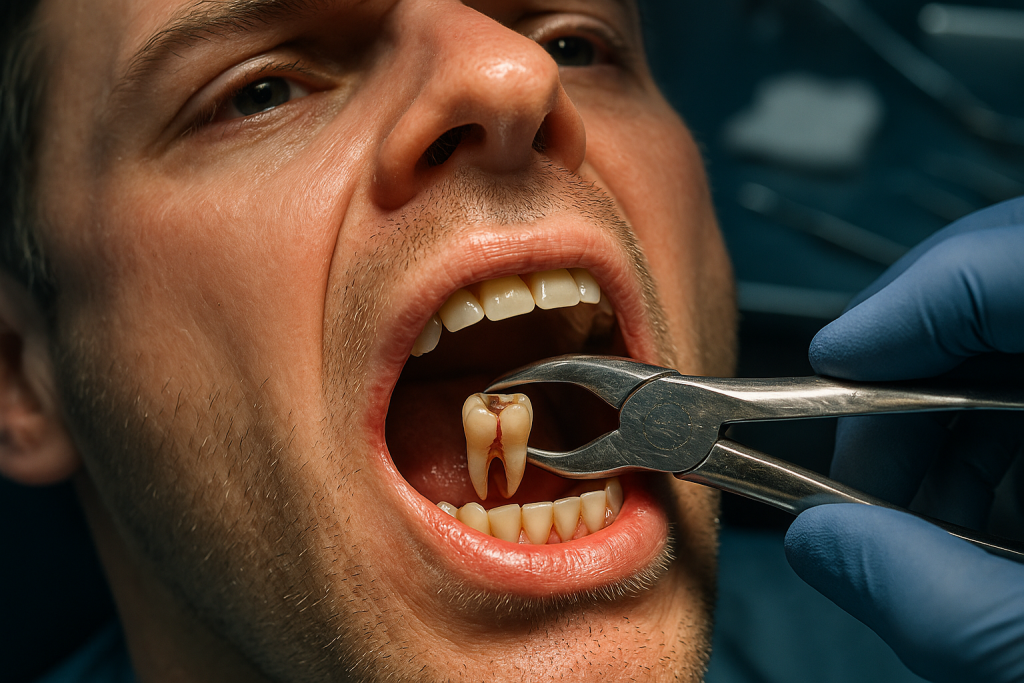
For a simple extraction, the dentist gently loosens the affected tooth. The affected tooth is firmly rocked back and forth to widen the space around it. Dental forceps may then be used to remove it from the tooth socket. Although people often use the word “pulling,” the process is usually controlled and gradual.
For surgical extractions, the process may include additional steps. The dentist or oral surgeon may make small cuts in the gum tissue to expose the tooth or bone. The tooth may be divided into smaller pieces so it can be removed safely. This approach may be used for a wisdom tooth, a tooth broken below the gumline, or a tooth close to a nerve or sinus area.
| Step | What Happens | What You May Feel |
| Exam and X-ray | Dentist checks the tooth, roots, bone, and nearby structures | Pressure from exam tools, no treatment yet |
| Numbing | Local anesthesia is placed near the tooth | Pinch, then numbness |
| Loosening | Tooth is gently moved to widen the socket | Pressure or movement |
| Removal | Tooth is removed with dental instruments | Pressure, not sharp pain |
| Socket care | Gauze is placed and bleeding is controlled | Mild pressure from gauze |
| Aftercare | Instructions are given for healing at home | Soreness as numbness fades |
Some procedures may involve an oral surgeon, especially if wisdom teeth are impacted, the root shape is complex, or the tooth is near the mandibular nerve or maxillary sinus. Your dentist can explain whether specialist care is needed.
What Happens after the Tooth Is Removed
Once the tooth is removed, the dentist will focus on protecting the socket and controlling bleeding. Gauze is placed over the extraction site so a blood clot can form. This clot protects the bone and supports healing.
You’ll be asked to bite down gently on the gauze for a set amount of time. If bleeding continues, the office may give you instructions for replacing the gauze. Light bleeding or pink saliva can be normal early on, but heavy bleeding that doesn’t slow should be reported.
If stitches are needed, the dentist will explain whether they dissolve on their own or need removal. Surgical extractions may involve stitches more often than simple extractions.
As the numb feeling fades, soreness can begin. Your dentist may recommend over-the-counter pain relief or prescribe medication, depending on the procedure and your health history. Follow the exact directions provided by the dental team.
During the first 24 hours, protect the clot by avoiding forceful rinsing, spitting, smoking, vaping, straws, and hard activity. These actions can disturb the clot and increase the risk of dry socket, which can cause stronger pain a few days after extraction.
You should also avoid hot foods and drinks right away. Soft, cool, or lukewarm foods are usually easier. Good choices may include yogurt, applesauce, mashed potatoes, scrambled eggs, soft pasta, and lukewarm soup.
Emergency Dental Squad’s website says dental pain shouldn’t wait and promotes fast exams, advanced digital X-rays, and immediate relief from pain.
Recovery, Gum Healing, and Things to Avoid
Recovery varies based on the type of extraction, the tooth involved, your overall health, and how closely aftercare instructions are followed. Simple extractions often have an easier recovery than surgical extractions, but each patient is different.
Most patients see gum healing begin within the first few days. The socket continues healing after that, and the deeper bone fills in over time. Surgical cases, wisdom teeth, infection, smoking, diabetes, and certain medications can affect healing speed. Your dentist can give a timeline based on your case. In many routine cases, early recovery improves over several days, while fuller healing may take around two weeks or longer depending on the procedure.
Follow these aftercare tips:
- Keep gauze in place as instructed. Replace it only if your dentist tells you to.
- Use cold compresses early. Apply them on the outside of the cheek in short intervals.
- Rest after the appointment. Avoid strenuous activity during early healing.
- Eat soft foods. Avoid crunchy, spicy, sticky, or very hot foods at first.
- Drink water gently. Don’t use a straw.
- Brush carefully. Keep your mouth clean, but don’t scrub the extraction site.
- Take medication as directed. Don’t change the dose without guidance.
- Call if symptoms worsen. Increasing pain, swelling, fever, pus, or a foul taste should be checked.
Things to avoid after tooth extraction include smoking, vaping, forceful spitting, aggressive rinsing, drinking through a straw, touching the socket, chewing on the treated side too soon, and ignoring pain that gets worse after day two or three.
Some patients worry about long-term side effects of tooth extraction. The main concern is often the missing tooth space. Depending on the location, a dentist may discuss implants, bridges, partial dentures, or dentures.
Fast Help for Tooth Extraction and Recovery Concerns
A tooth extraction can be much less stressful when you know what to expect. The dentist examines the tooth, numbs the area, removes the affected tooth using the safest method for your case, protects the socket, and gives you recovery instructions. The process is focused on comfort, safety, and stopping the dental problem from getting worse.
Emergency Dental Squad helps patients find local emergency dental care for toothaches, infections, broken teeth, dental extractions, X-rays, crowns, dentures, and other urgent needs. Same-day appointments may be available depending on your location and the provider’s schedule.
If pain, swelling, or a broken tooth is disrupting your day, call Emergency Dental Squad 24/7. You can speak with a local dentist, ask about urgent extraction options, and get help finding care near you.
